 EN
 English
 Español
 عربى


Product Consultation
Your email address will not be published. Required fields are marked *
A fabrication shop logs its air demand for a week and finds a peak of 6.4 m³/min at 7 bar, with long stretches running between 3 and 5 m³/min. That profile points to one answer: a 50HP air compressor. Fifty horsepower is 37 kW, and a modern oil-injected single-stage screw package at that size usually delivers 5.5 to 6.9 m³/min — roughly 195 to 245 cfm — depending on discharge pressure.
The short conclusion: 50HP is the right class when real demand lands between about 5 and 6.5 m³/min at 7–8 bar. Everything after that is verification — confirming the delivery figure was measured at your working pressure, comparing specific power instead of sticker price, and checking that the package draws the current your electrical room can actually supply.
The 50HP figure describes the motor's nominal shaft output, not what the package pulls from your panel. A 37 kW motor running near full load converts roughly 39 to 40 kW of electrical input into shaft power once motor efficiency is accounted for, and the cooling fan, controller and drive losses add a few more kilowatts. Expect a 50HP screw compressor to register about 41 to 43 kW on a power meter at rated conditions.
That gap matters at the quoting stage for two reasons. First, current draw: a 37 kW motor typically pulls around 64 A at 400 V and about 55 A at 460 V at full load, so cables, breakers and starting equipment must be sized on that basis rather than on the motor rating alone. Second, running cost: every hour at 41 kW consumes 41 kWh. At 4,000 operating hours a year that is 164,000 kWh, which over a decade usually exceeds the purchase price several times over.
Motors are also built with a service factor, often 1.15, which permits brief overload without damage. It is not a licence to size a 50HP unit for a 45 kW continuous load. A compressor run permanently into its service factor will not reach the bearing and airend life its datasheet promises.
Free air delivered, or FAD, is the only figure that tells you whether a 50HP compressor will carry your tools. It falls as pressure rises, because the same motor has to work against a higher head. A typical 37 kW single-stage oil-injected package moves through the range shown below.
| Discharge pressure | Free air delivery | Package input | Specific power |
|---|---|---|---|
| 7 bar | 6.6 m³/min (233 cfm) | 41 kW | 6.2 kW per m³/min |
| 8 bar | 6.2 m³/min (219 cfm) | 41 kW | 6.6 kW per m³/min |
| 10 bar | 5.3 m³/min (187 cfm) | 41 kW | 7.7 kW per m³/min |
| 13 bar | 4.2 m³/min (148 cfm) | 41 kW | 9.8 kW per m³/min |
Read the table the other way round when comparing quotes. Two machines can both be labelled 50HP and 8 bar while one delivers 5.9 m³/min and the other 6.5 m³/min; the difference is usually an airend matched to a different rotor tip speed or an oversized drive train, and it shows up as a double-digit gap on the electricity bill. Ask for delivery at your actual working pressure, because a unit rated at 7 bar and tested at 10 bar will always look worse than the brochure suggests.
Typical free air delivery by motor size (oil-injected, single-stage, 8 bar)
Indicative figures for comparison only; confirm against the datasheet of the exact model you intend to buy.
At 50HP, single-stage is the practical choice. Two-stage airends split compression into two steps with intercooling, and they earn their extra cost mainly above 10 bar or in the 100HP-and-up classes where an 8–15% efficiency gain pays back quickly on long duty cycles. In our own range, the single-stage oil-injected line runs from 10HP to 75HP, and two-stage machines start at 100HP.
If you run continuously above 10 bar, or three shifts with a steady load, two-stage becomes worth modelling rather than dismissing. The trade-offs are set out in this comparison of two-stage compression efficiency, which is the right reading before you accept a higher purchase price for a small delivery gain.
The 50HP model in that single-stage series is the direct match for the demand band discussed here, and its page lists the delivery, motor and connection data you should check against your site conditions.
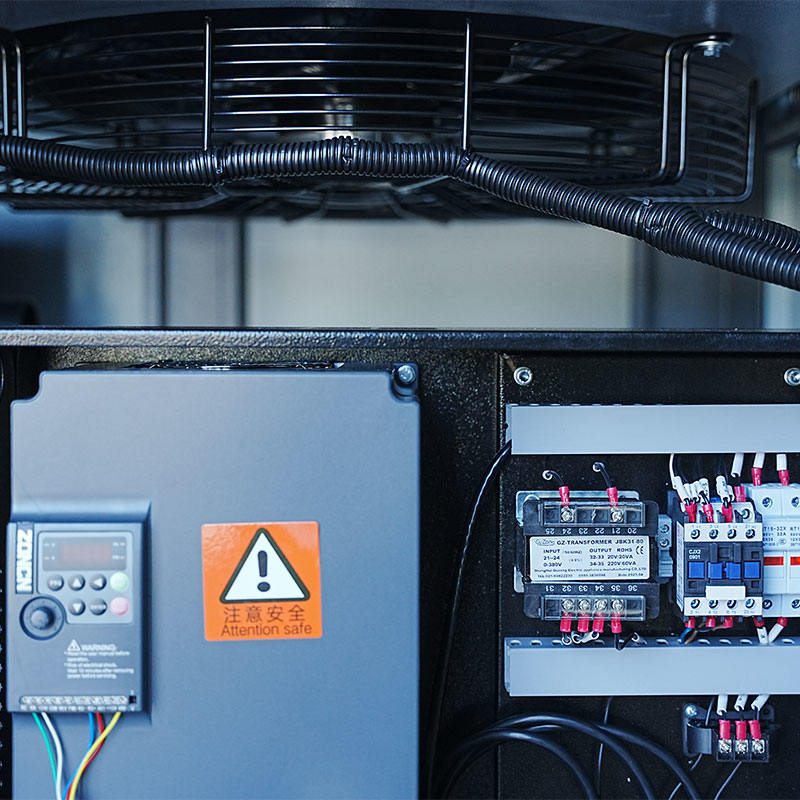 50HP Micro-Oil Single-Stage Twin-Screw Air CompressorReview this 50HP micro-oil single-stage compressor for the demand band discussed, using its delivery, motor and connection details to compare against site conditions.View Product →
Guessing at demand is how plants end up with a 50HP unit that short-cycles, or a 30HP unit that cannot hold header pressure at ten in the morning. Log the system instead: a week of one-minute interval data on the main header shows the peak, the average, and how often the compressor unloads.
Two adjustments sit on top of the measured peak. Leakage commonly accounts for 20–30% of compressed air production in plants that have never been surveyed, and it grows back after every repair round, so either fix it first or carry a margin for it. Then add 15–25% for future load, filter fouling and pressure drop across dryers and piping. A shop peaking at 6.4 m³/min is not over-equipped with a 6.2 m³/min machine once a receiver and a dryer are in the loop.
One-shift demand profile, m³/min (peak 6.9, average 4.9)
A 50HP machine at 6.2 m³/min covers the peak only when a receiver absorbs the short spikes above it.
Storage does much of the work in a profile like this. As a rule of thumb, allow 2,000 to 3,000 litres of receiver volume for a 6 m³/min compressor serving fluctuating demand. The tank absorbs short peaks, lets the motor unload instead of cycling, and cushions the lunchtime collapse and the afternoon restart.
Variable speed is the other decision. A VSD 50HP compressor earns its premium when demand genuinely swings — the profile above, with a 2.2 m³/min lunchtime trough, is a fair candidate. On a steady three-shift load that sits within 10% of the machine's rating all day, a fixed-speed unit with generous storage usually returns the money faster.
Quotations for 50HP machines look alike on the first page and diverge on the second. Compare these items line by line before the price discussion starts.
A 50HP unit should be chosen from a range rather than in isolation, because the step up or down in motor size often fits a measured load better than the nominal class you started with.
Roughly 90% of the electrical input leaves a screw compressor as heat, so a 41 kW package rejects about 36 kW into the room. Ventilation has to remove it: at a 10°C temperature rise that means around 2.5 to 3 m³/s of air, ducted in low and out high. A compressor starved of cooling air derates, trips on high discharge temperature and shortens its oil life.
Practical installation points for a 50HP package: allow a metre of clearance around the enclosure and more above the cooler; avoid drawing hot air off the dryer; fit a condensate drain that does not trickle oil onto the floor; and place the dryer and filters where someone will actually service them. If you want to see how machines are built and tested before they ship, our plant and equipment page walks through the production and inspection stages.
Run the arithmetic before the negotiation. At 41 kW and 4,000 hours a year, the unit consumes 164,000 kWh annually; at USD 0.10 per kWh that is USD 16,400. A 5% better specific power saves USD 800 every year for the life of the machine, which is why a slightly higher purchase price for a genuinely more efficient airend is usually the cheaper decision.
A 50HP screw compressor suits general workshop air, packaging lines, textile machinery and fabrication cells running several pneumatic tools at once. It is also the size that pairs naturally with laser cutting, where the compressor, receiver and dryer have to be arranged around a machine that starts and stops abruptly and is sensitive to pressure drop.
Where the air touches the product — food, pharmaceutical, electronics or breathing air — the oil question changes the calculation. Oil-free compression removes the risk of carryover into the process entirely, at the cost of a higher purchase price and stricter service discipline. The oil-free single-stage range covers that requirement.
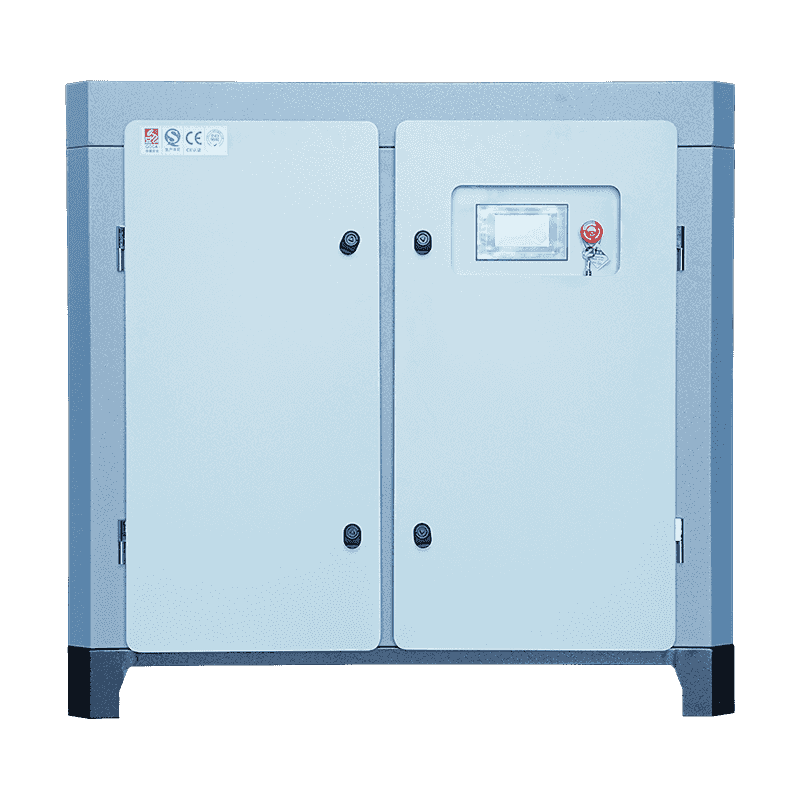 Custom Oil-Free Single-Stage Screw Air CompressorConsider this oil-free single-stage compressor where air contacts the product; its integrated permanent-magnet motor and variable-speed operation target stable, low-noise, energy-efficient compressed air.View Product →
For most plants the decision ends here: if a week of logging shows a peak between 5 and 6.5 m³/min at 7–8 bar, a 50HP air compressor with a properly sized receiver, dryer and ventilation path will hold header pressure comfortably through the shift. Ask every supplier for delivery and specific power at your pressure, confirm the 37 kW motor and its full-load current, and treat the efficiency gap between two quotes as a decade-long line item rather than a rounding error.
Your email address will not be published. Required fields are marked *
A dedicated after-sales service department is established, consisting of a professional sales team and skilled technical engineers. They are committed to providing year-round support, traveling to customer locations to deliver prompt and high-quality service.

Tel:86-0570-7221666

E-mail:[email protected]

Add: No.2 Qiming Road, Zhejiang Longyou Economic Development Zone, Mohuan Township, Longyou County, Quzhou City, Zhejiang Province, China
Copyright © Zhejiang Haidebao Industrial Technology Co., Ltd.

Custom Industrial Screw Air Compressor Manufacturers