
 EN
EN  English
 Español
 عربى
عربى
Product Consultation
Your email address will not be published. Required fields are marked *

Learning how to use an air compressor correctly requires a structured approach that prioritizes checking pump oil levels, establishing secure pneumatic line coupling, and setting the precise output pressure using the regulator dial. To safely harness pneumatic power, an operator must always verify that the tank drain valve is closed before engaging power, allow the pressure switch to cut off automatically at maximum tank capacity, and adjust the regulated line gauge to match the specific tool requirements. Following this sequence prevents premature equipment wear, eliminates sudden air line decoupling, and ensures consistent cubic feet per minute (CFM) air delivery across any task.
Whether dealing with a small oil-free pancake unit or an industrial-grade rotary screw system, an air compressor operates on basic principles of thermodynamic reduction. By mechanically drawing in ambient atmospheric air and compressing it within a reinforced steel storage tank, the system converts mechanical energy into highly controllable pneumatic force. Mismanaging this stored energy or misinterpreting pressure gauges can cause tool damage or hose ruptures, making it essential to understand the system's mechanics before activating the power switch.
Before turning on the machine, you must understand its physical layout. A standard workshop compressor includes two distinct pressure gauges and several safety mechanisms designed to manage the high pressure within the steel shell.
The first gauge, located closest to the main tank body, shows the internal pressure of the storage tank, which typically ranges from 90 PSI to 175 PSI (Pounds per Square Inch) depending on the compressor's capacity. The second gauge shows the regulated line pressure, which is the actual air force traveling through the hose to your tool. Adjusting the regulator knob lets you alter this output line pressure without affecting the core storage reservoir pressure inside the tank.
If the automatic pressure cutoff switch fails to disconnect the motor circuit when the tank is full, pressure will continue to rise dangerously. To prevent a structural tank rupture, a manual brass safety valve is built directly into the manifold. Pulling the ring on this valve manually exhausts internal pressure, confirming that the safety mechanism opens freely and isn't blocked by internal corrosion or scale.
A common mistake when learning how to use an air compressor is confusing pressure (PSI) with volume flow rate (CFM). Every tool needs a specific combination of both metrics to run correctly without draining the air reservoir too quickly and overheating the pump motor.
| Pneumatic Tool Classification | Optimal Pressure Boundary (PSI) | Minimum Volumetric Flow (CFM @ 90 PSI) | Recommended Storage Capacity |
|---|---|---|---|
| Precision Finish Brad Nailer | 70 - 90 PSI | 0.5 - 1.5 CFM | 1 - 6 Gallons (Pancake Portable) |
| Heavy-Duty Dual-Action Sander | 90 - 100 PSI | 10.0 - 14.0 CFM | 60+ Gallons (Stationary Two-Stage) |
| HVLP Automotive Finish Spray Gun | 25 - 40 PSI | 8.0 - 12.0 CFM | 20 - 30 Gallons (Vertical High-Flow) |
| Heavy Impact Wrench (1/2 Inch Drive) | 90 PSI | 4.0 - 6.0 CFM | 8 - 20 Gallons (Mid-Size Mobile) |
When calculating requirements for continuous-run tools like sanders or grinders, always choose a machine whose CFM output exceeds the tool's rating by at least 50%. This padding ensures that the compressor pump can periodically cycle off and cool down, rather than running non-stop and risking thermal overload or oil oxidation.
Following a structured workflow ensures your air compressor starts smoothly every time. This sequence balances electrical loads and checks mechanical connections before the system pressurizes.
Compressing ambient air concentrates more than just oxygen and nitrogen molecules; it also concentrates atmospheric water vapor and micro-fine dust particles. Managing these byproducts is critical to keeping your pneumatic tools working reliably over time.
When you finish your work, you must properly shut down and store the machine. Skipping these steps can lead to internal tank rust, which weakens the steel shell over time and reduces its burst rating.
First, push the main pressure switch down into the "Off" position and disconnect the electrical power cable from the wall outlet. Turn the line regulator knob counterclockwise to vent the remaining pressure from the supply hose, then disconnect the tool from the quick-coupler. With the main tank pressure safely below 20 PSI, place a shallow pan beneath the underside drain valve and slowly turn the valve assembly counterclockwise.
As the valve opens, a mixture of pressurized air and rusty water will escape from the bottom of the tank. Let the valve stay open until all liquid moisture is completely cleared out. Leave the valve slightly open during storage to allow fresh airflow through the tank shell, which helps dry out any remaining moisture and prevents internal corrosion while the machine is sitting idle.
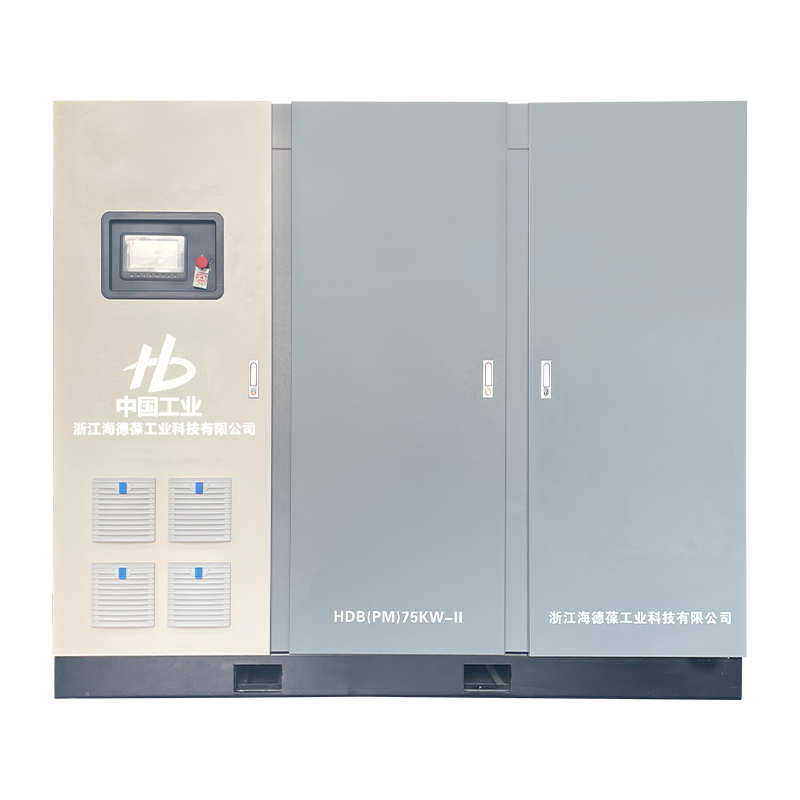
Less Oil, More Air: The Engineering Case for the Micro-Oil Screw Air Compressor

Water Abatement Mechanics: Engineering Protocols to Remove Moisture from Industrial and Commercial Air Compressor Lines
Your email address will not be published. Required fields are marked *

A dedicated after-sales service department is established, consisting of a professional sales team and skilled technical engineers. They are committed to providing year-round support, traveling to customer locations to deliver prompt and high-quality service.

Tel:86-0570-7221666

E-mail:[email protected]

Add: No.2 Qiming Road, Zhejiang Longyou Economic Development Zone, Mohuan Township, Longyou County, Quzhou City, Zhejiang Province, China
Copyright © Zhejiang Haidebao Industrial Technology Co., Ltd.

Custom Industrial Screw Air Compressor Manufacturers