
 EN
EN  English
 Español
 عربى
عربى
Product Consultation
Your email address will not be published. Required fields are marked *

The comparison between a micro-oil system and a traditional one begins with understanding their fundamental operational principles. A standard twin screw air compressor operates on a well-established method of injecting a large volume of oil into the compression chamber. This oil serves multiple critical functions: it acts as a coolant to absorb the heat of compression, it seals the clearances between the rotors and between the rotors and the housing to prevent internal leakage, and it lubricates the bearings and gears. The resulting air-oil mixture then exits the compression chamber and passes through a multi-stage separation process to remove the majority of the oil before the compressed air is delivered to the system. In contrast, a micro-oil twin screw air compressor is designed around a philosophy of oil minimization. It still utilizes oil, but the quantity injected is precisely controlled and substantially reduced. This approach necessitates changes in rotor profiles, bearing technology, and cooling strategies to manage the reduced lubrication and sealing effects. The core idea is to provide just enough oil to perform essential lubrication and sealing, thereby reducing the energy penalties associated with processing a large volume of oil.
In a conventional oil-flooded or lubricated twin screw compressor, oil is integral to the compression process itself. The volume of oil circulated can be many times the volume of free air delivered. This massive quantity is required because the oil is the primary medium for heat removal. As the air is compressed, its temperature rises dramatically, and the oil, injected directly into the rotors, absorbs this heat, carrying it away to an oil cooler. This prevents the compressed air from reaching excessively high temperatures that could damage the downstream equipment or the compressor itself. Furthermore, the oil's viscosity helps create a hydraulic seal between the male and female rotors. This seal is crucial for maintaining volumetric efficiency; without it, air would slip from the high-pressure side back to the low-pressure side within the rotor pockets, reducing the amount of air effectively compressed per revolution. The oil also forms a film between the rotating screws, preventing metal-to-metal contact and reducing wear. While effective, this heavy reliance on oil introduces inherent energy losses related to pumping, separating, and cooling this large fluid volume.
The design of a micro-oil system represents a deliberate shift in how oil is utilized. Instead of flooding the compression chamber, these compressors employ a much more targeted injection system, often using nozzles that atomize a small, calculated amount of oil into the chamber. The goal is not to use oil as the primary coolant but to ensure sufficient lubrication of the rotors and a minimal seal to control internal leakage. To compensate for the reduced cooling capacity of the oil, micro-oil designs often feature other cooling methods. This can include more efficient air-cooling of the compressor housing or the use of a liquid-cooled jacket around the compression element. The rotors themselves may have specialized coatings, such as PTFE or other advanced materials, to reduce friction and wear in a lower-oil environment. The bearings are often of a higher-grade, sealed-for-life type that does not rely on the circulating oil for lubrication. This re-engineering of the entire compression element allows the system to function reliably with a fraction of the oil traditionally required, which is the source of the efficiency gains.
One of the most direct areas of efficiency improvement in a micro-oil twin screw air compressor is the reduction in parasitic power loss associated with oil circulation. In a traditional system, a substantial oil pump is required to move a large volume of oil from the separator, through a filter, into an oil cooler, and then back into the compression chamber at a pressure higher than the final air pressure. The power required to drive this pump is a constant drain on the system's total energy consumption. By drastically reducing the volume of oil that needs to be moved, a micro-oil system can utilize a smaller, less powerful oil pump. This directly translates to lower electrical draw. Furthermore, the work required to push the air-oil mixture through the separator is also reduced. Less oil means the mixture has a lower density and viscosity, resulting in a lower pressure drop across the separator vessel. The energy saved by not having to overcome this pressure drop contributes to the overall improvement in the main unit's efficiency.
Inside the compression chamber of a twin screw compressor, the presence of a large quantity of oil creates a certain amount of fluid dynamic drag or resistance. As the rotors turn, they must move not only the air but also the thick oil that fills the inter-lobe spaces and the clearances. This internal resistance requires the motor to expend extra power, beyond what is needed for the actual compression of the gas. In a micro-oil system, this internal resistance is considerably lower. With significantly less oil present in the compression chamber, the rotors encounter less viscous drag. This means more of the motor's power is directed toward the primary task of compressing air, and less is wasted on churning oil. This reduction in internal power loss contributes to a higher adiabatic efficiency for the compression element itself. The compressor can achieve the same pressure ratio with less input torque, which is a fundamental improvement in its mechanical and thermodynamic performance.
While it may seem counterintuitive, using less oil can lead to better thermal management in some aspects of the cycle. In a traditional compressor, the oil absorbs the heat, but this heat then has to be removed by a large oil cooler, which itself requires energy (for fans or cooling water pumps). The large volume of oil also occupies space within the rotor pockets, effectively reducing the volume of air that can be ingested in each cycle, which slightly impacts volumetric efficiency. A micro-oil system, by design, allows for a higher mass of air to be processed relative to the mass of oil. The heat is managed more directly, often through the compressor casing, which can be a more efficient path for heat rejection in certain designs. The reduced oil volume means less space is occupied by non-compressible fluid within the compression chamber. This allows the rotors to trap a slightly larger volume of air per revolution, leading to a marginal but measurable increase in volumetric efficiency. More air delivered per unit of input power is the definition of improved specific power performance.
| Efficiency Factor | Traditional Oil-Flooded Method | Micro-Oil Method |
|---|---|---|
| Oil Circulation Power | High power draw for large pump to overcome high pressure drop in separator and cooler | Low power draw for smaller pump due to reduced oil volume and lower system pressure drop |
| Internal Drag | Higher parasitic losses from rotors churning a large volume of oil | Lower parasitic losses due to reduced oil presence in the compression chamber |
| Volumetric Efficiency | Slightly reduced as oil volume occupies part of the rotor intake pocket | Marginally improved as less oil volume allows for a higher air mass intake per revolution |
| Heat Rejection Path | Primarily via oil, requiring a large oil cooler and associated energy for cooling | More direct heat rejection via compressor casing, potentially reducing cooler size and energy |
The culmination of these individual improvements is reflected in the key industry metric of specific power, typically expressed in kilowatts per 100 cubic feet per minute (kW/100 cfm). This figure represents the amount of electrical energy required to produce a given flow of compressed air at a specified pressure. Due to the combined effects of lower oil pump power, reduced internal drag, and marginally better volumetric efficiency, a micro-oil twin screw air compressor will generally exhibit a lower specific power rating than a comparable traditional model. For example, where a traditional compressor might have a specific power of 18 kW/100 cfm, a micro-oil version of the same capacity might achieve 17 kW/100 cfm or less. This difference, while seemingly small on a per-unit basis, accumulates into substantial energy cost savings over the operational life of the compressor, especially in applications with high run hours. This reduction in specific power is the most direct and quantifiable demonstration of the main unit efficiency improvement.
The efficiency benefits of a micro-oil design are often amplified when paired with modern control strategies, most notably variable speed drives (VSD). A VSD allows the compressor to precisely match its motor speed and air output to the fluctuating demand of the plant, avoiding the energy waste associated with running at full load and then venting or idling. The inherent efficiency of the micro-oil compression element provides a better baseline from which the VSD can operate. When the demand is low, the VSD slows the compressor down. In a micro-oil machine, the reduced oil circulation and lower internal drag are present at all speeds, meaning the efficiency advantage is maintained across the entire operating range, not just at full load. This synergy between an efficient core design and an intelligent control system allows for energy savings that go beyond what either technology could achieve on its own, particularly in part-load scenarios which are common in most industrial settings.
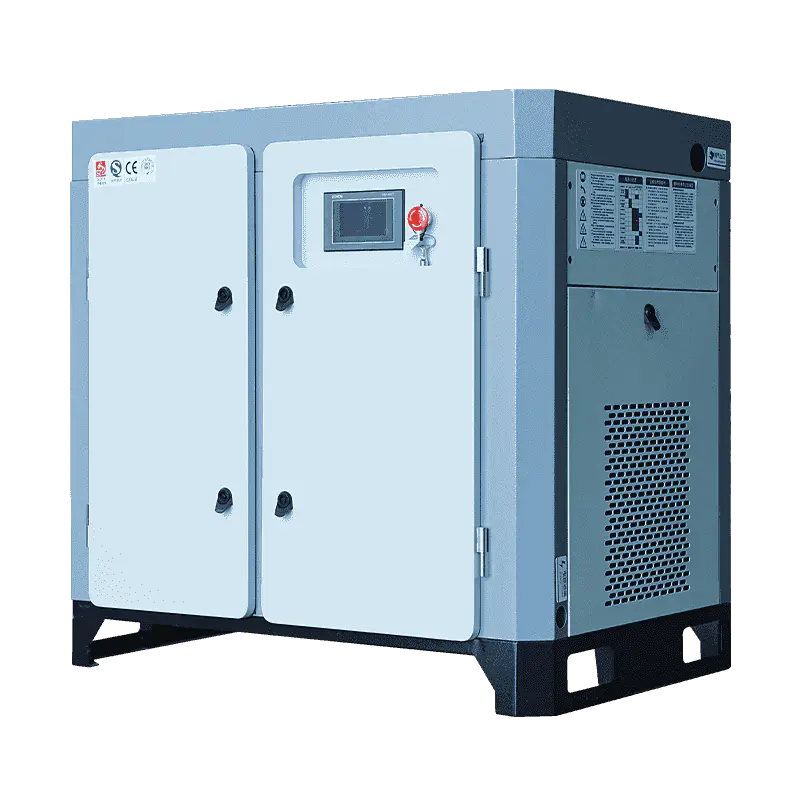
The Ultimate Guide to Air Compressors: Types, Uses, and Buying Guide

How stable is the performance of the micro-oil twin screw single-stage compressor under different operating conditions?
Your email address will not be published. Required fields are marked *

A dedicated after-sales service department is established, consisting of a professional sales team and skilled technical engineers. They are committed to providing year-round support, traveling to customer locations to deliver prompt and high-quality service.

Tel:86-0570-7221666

E-mail:[email protected]

Add: No.2 Qiming Road, Zhejiang Longyou Economic Development Zone, Mohuan Township, Longyou County, Quzhou City, Zhejiang Province, China
Copyright © Zhejiang Haidebao Industrial Technology Co., Ltd.

Custom Industrial Screw Air Compressor Manufacturers